Omogbehin Olushola
Leaders of the opposition African Democratic Congress and others have moved against the amended Electoral Act 2026 recently assented to by President Bola Ahmed Tinubu.
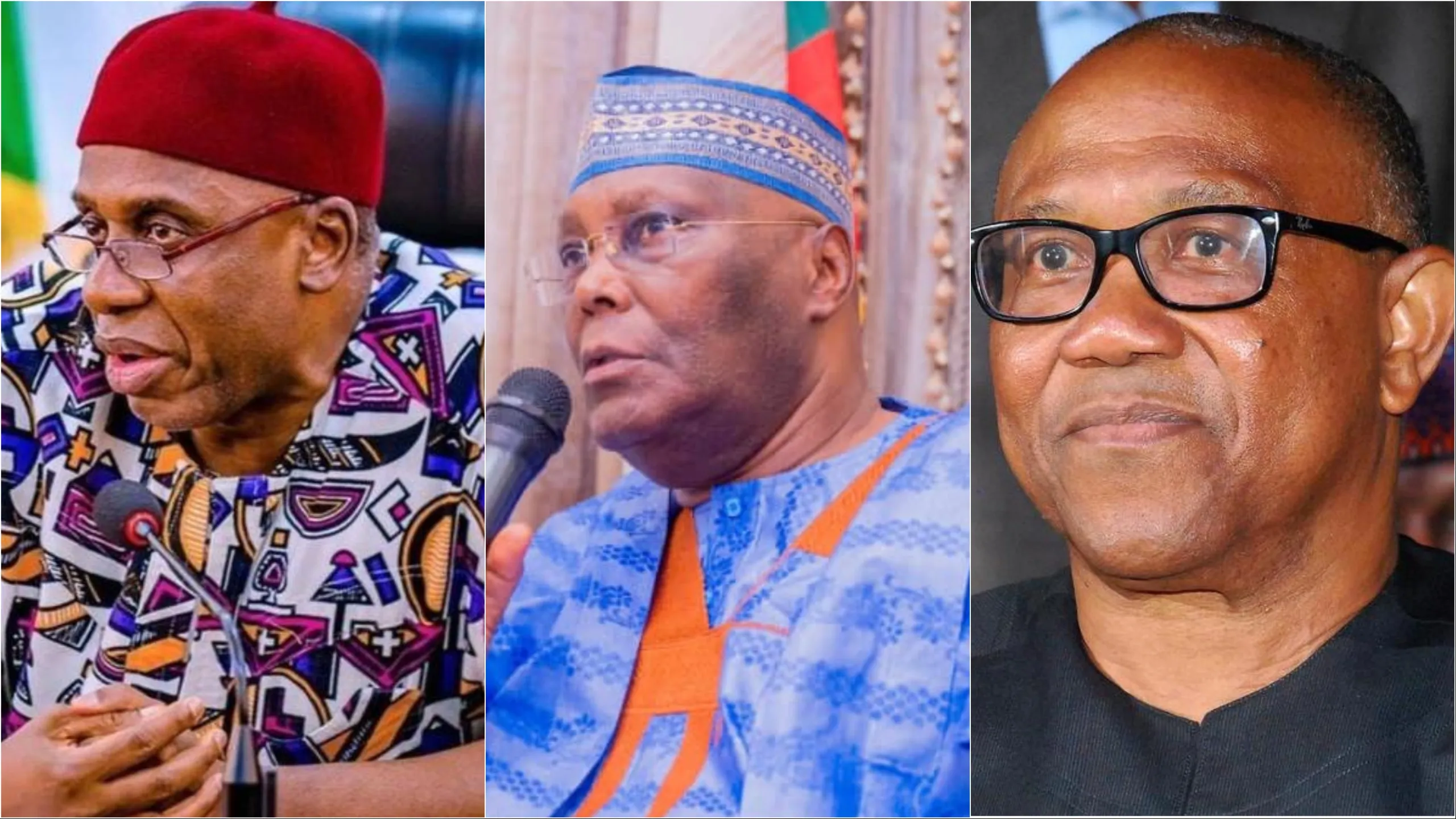
The move which was championed by the leading opposition leaders in the country – Atiku Abubakar, Peter Obi and Rotimi Amaechi have been dismissed by the Senate saying they should pursue their concerns within the framework of the National Assembly.

The trio on Thursday mounted fresh pressure on the National Assembly to demand immediate amendment of the Electoral Act 2026, which they described as anti-democratic.
Ajuri Ahmed of the New Nigeria People’s Party (NNPP) during a press briefing, accused the ruling All Progressives Congress (APC) of making effort to make President Tinubu as the sole credible presidential contender ahead of the 2027 general elections.
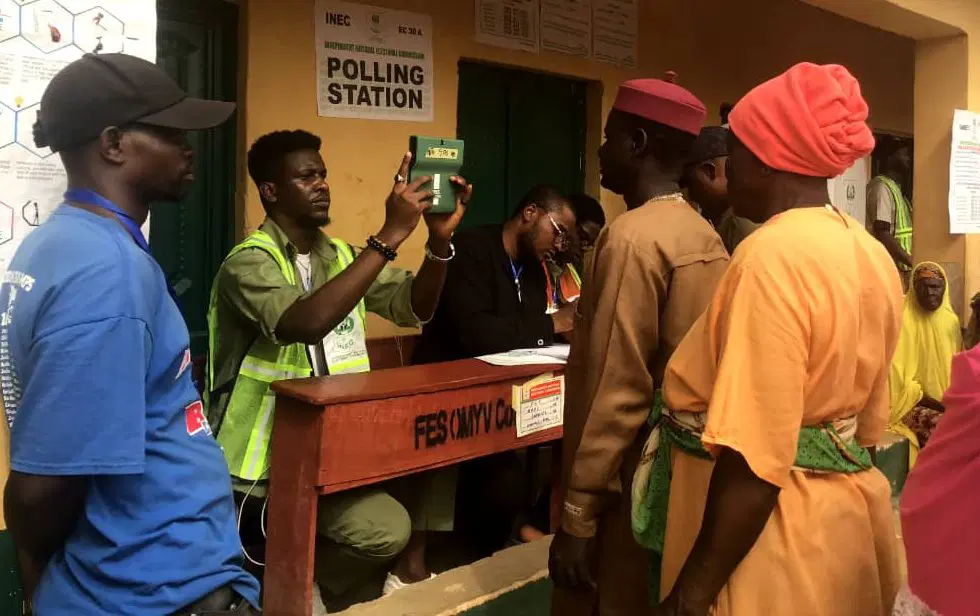
Questioning the rationale behind retaining a manual transmission provision in the new law, Ahmed said data at their disposal shows that results can be electronically transmitted from all polling units nationwide.
Ahmed who was also surprised at the swiftness with which the President approved the bill, said such speed was not followed in signing other pieces of legislation.

Speaking, Ahmed said: “We therefore state unequivocally that the new Electoral Act is anti-democratic, and its implementation will undermine electoral transparency and the sanctity of the ballot, which are fundamental to free, fair, and credible elections and the bedrock of participatory democracy.
“The introduction of the proviso in Section 60(3), which allows wide and undefined discretionary powers to the presiding officer, overrides and negates the purpose of introducing electronic transmission of election results from polling units. This negation is unambiguously intended to provide a blank check to those who seek to manipulate election results by delaying the electronic transmission of results from the polling units to the IREV on the pretext of network failure.
“The premise of the proviso in Section 60(3) is the unavailability or possibility of network failure. We find this premise dubious and inconsistent with reality. The immediate past INEC Chairman, Prof. Mahmud Yakubu, stated on record that the BVAS equipment, which operates offline, had worked with over a 90 per cent success rate across the nation, and in the event of network failure at the point of transmission, the transmitted results would be delivered successfully whenever the network is available.”
He further analysed that: “According to the Nigerian Communications Commission, as of 2023, Nigeria had achieved more than 95 per cent 2G coverage, which is more than sufficient for the transmission of election results from polling units.

“By that same period, Nigeria already had more than 159 million internet subscribers and more than 220 million telephone subscribers using the 2G network. It is also noteworthy that this capacity provides 24-hour coverage of the entire country. This goes to show that denying mandatory real-time transmission of election results from polling units on the basis of lack of communication network is not supported by evidence.
Concerning party primaries, in the Electoral Act 2022, political parties were permitted to nominate candidates through direct primaries involving all registered members, indirect primaries conducted by delegates, or by consensus arrangements reached by party leaders.
The 2026 Electoral Act passed by the National Assembly and assented to by President Bola Tinubu on February 18 restricts parties to only direct primaries and consensus options. The new law also shortens campaign periods and timelines for primaries.
Ahmed however said: “There is nothing undemocratic about indirect primaries, which create an electoral college for the selection of candidates in an objective, transparent, and orderly manner.”
The 2023 Labour Party presidential candidate, Peter Obi, decried the rising poverty rate, saying that there is no result to justify the heavily borrowed money by the APC-led Federal Government.
“We have the same view, but it is important that we repeat it as often as we can so that Nigerians know we are together. There is a need for a genuine opposition party. Those who are not here today — we are pleading that we all come together to save our dear country.
“The government we have today and that continues is the worst ever in our country. There is no governance in Nigeria. The legislature is at its worst. The judiciary is no longer the hope of the weak or the poor. Insecurity, killings, and abductions are worse than even in countries at war. Just in the past week, I mentioned killings in Zamfara on Friday, and today, even while we are speaking, over 20 already (killed) in Adamawa. It is all about the country; I just mentioned a few.
“Poverty has increased dramatically in the past two and a half years — from about 87 million to about 140 million today, the highest in any country on earth. In fact, we now have almost over 30 per cent of the world’s poor people living in Nigeria. We now have more poor people living in Nigeria, a country of about 240 million, than China and India combined.”
Also speaking, former 2023 APC presidential aspirant Rotimi Amaechi said that the real challenge for the opposition was not President Tinubu, but the strategies employed by the opposition.
“Actually, Tinubu is not our problem; the opposition is the problem of the opposition. The first thing we must know is that we must separate ourselves from the government in power. I said in one of these conferences that when I was in government, (Muhammadu) Buhari wanted electoral reform. So, a few ministers went to him and convinced him not to sign — that if he signed, Russia would hack the system and impose the wrong President on us. And he refused to sign.”
Vice-President Atiku Abubakar appealed that the position of opposition leaders on the electoral process be submitted to all foreign embassies.
“And again, what you must bear in mind is that the collapse of democracy in Nigeria is going to lead to the collapse of democracy in Africa because we are the largest democracy in Africa. These are some of the consequences that will definitely affect other democracies in Africa.
“So, I will call on other opposition parties that are not here to make sure that they are part of this movement for the unity of opposition parties to ensure we restore our democracy.”
The coalition of opposition leaders also dismissed the outcome of the just concluded FCT Area Council election.
According to them, it served as a crucial test for the new Independent National Electoral Commission (INEC) Chairman, which they believe he failed.